


Dancho Nestorov, our Ecommerce Strategy Lead, stood in front of a room full of Irish retailers asking if they were actively trying to grow their ecommerce revenue. No surprise, almost every hand in the room went up.
Dancho had a follow up question…
“How many people are actively working on initiatives to secure the profitability of that growth?
Suddenly there were far fewer hands in the air.
But Dancho wasn’t surprised by that either. It’s incredibly common in ecommerce to focus on growth without first assessing what impact growth will actually have on the bottom line.

A growth strategy that backfire
Not so long ago, we had a client come to us for help after their growth strategy worked… but didn’t have the expected results. Let’s call them Client X.
Strong brick-and-mortar brand, with a loyal customer base, and their ecommerce was growing. So the leadership team decided to lean into that growth and set an ambitious target. They would double ecommerce revenue in 18 months.
They set out a solid growth strategy, employing best practice approaches and proven tactics. On paper, everything looked peachy. And, in a way, the strategy worked. ecommerce orders increased massively.
However they didn’t crack open the champagne bottles, because there was a major problem. Margins were decimated and the increase in sales didn’t increase profitability. In fact, it was quite the opposite. The business was making less money as sales grew.

Why good growth tactics can still lose money
This isn’t an isolated case. We see similar stories all the time. It’s entirely possible to do what looks like the right thing but at the wrong time, and to disastrous effect.
A simple (and common) example would be increasing ad spend before understanding the allowable customer acquisition costs.
It’s easy to see how this could go horribly wrong.
Let’s take a hypothetical product, selling for €100 with a gross margin of €20. You’re spending €12 in ads to get a sale, giving you an 8.3x return on ad spend in your marketing dashboard. Looks great in isolation. But payment fees, fulfilment, and delivery costs add up to €10, so it turns out you’re losing €2 on every order.
Increasing orders through ads makes sense, just not before knowing what you can profitably afford to spend.
That’s a simple illustration. What often happens is that the complexity of an ecommerce operation makes it difficult to see all the places where profit can leak away as you grow.
In Client X’s case, they had a strong playbook for growth, but they implemented it before carrying out an assessment of the foundations.

One of the biggest mistakes I see in ecommerce is applying a standard growth playbook before understanding what is actually constraining the business. What works for one business can be completely wrong for another. More spend, more channels, more CRO can all be effective… but only when they solve the right problem. The businesses that scale profitably don’t simply do more. They diagnose first, then invest in the right lever, in the right order.

The four foundations of profitable ecommerce growth
To prepare for growth you have to first diagnose any constraints in the business that could turn a growth strategy into a money pit.
There are four foundations to examine.
1: Unit Economics
Unit economics is about understanding whether the orders you generate make financial sense. This means going deep into product margins, acquisition costs, and what different products or categories contribute after payment fees, picking, packing, delivery, the cost of returns and other variable costs. You need to know how much you can spend on acquisition while keeping the first order commercially viable. If you don’t have your unit economics figured out, no amount of features or marketing can compensate for it.
2: Customer Economics
In some businesses, the first order will be profitable on its own. But for many retailers, the full cost of acquiring a customer only makes sense if that person becomes a repeat customer. Customer economics looks beyond that first order to assess what proportion of customers purchase again, how soon they return, what they tend to buy next, and how their lifetime value compares with the cost of acquiring them. You can justify spending more to acquire the right customers when their expected future value supports it.
3: Operational Readiness
Operational readiness is about whether the business can absorb increased demand. Growth can tie up more cash in stock, increase the importance of accurate forecasting, require stock to be replenished quickly enough to keep pace with demand, and place additional pressure on fulfilment capacity. Before scaling, you need to know that each part of the operation can keep pace with sales, particularly during peak trading periods.
4: Strategic Priority
Strategic priority is about deciding where to focus first. Before increasing acquisition spend, you may need to improve the value generated from existing traffic. Before investing in CRO, you need to know that additional orders will make commercial sense. Before building sophisticated email flows, you need to capture enough email addresses to make them worthwhile. The priority should be the initiative that makes the most commercial sense for your business right now, not simply the next tactic on the ecommerce playbook.

A good example of why diagnosis matters came from a retailer who was convinced their conversion rate was the issue. Believing their website was holding them back, they came to us looking for a full redesign. But when we looked at the wider picture, the online store was receiving relatively little traffic compared with the size of the audience engaging with the business elsewhere. Even a major improvement in conversion rate would have had a limited impact on revenue. The bigger opportunity was working out how the online store could play a bigger role in the overall customer journey. Understand what’s really limiting the business first, then decide where to invest.

What to fix before you push for more growth
In the case of Client X, we used the diagnostic framework to figure out why their growth strategy had backfired, and implement solutions:
- They were investing in acquisition before generating enough value from their existing traffic, so we prioritised site merchandising and revenue per visitor before increasing ad spend.
- They were promoting low-margin products as aggressively as more profitable ones, so we developed a clearer understanding of margin by category and redirected promotional spend accordingly.
- Products were taking too long to be listed online, leaving fewer days to sell them at full margin, so we improved the internal product-listing process.
- The business was overly dependent on acquiring new customers, so we improved email capture, built essential email flows and launched a second-sale programme based on common purchase sequences.
With these solutions in place the foundations could support their ambitious growth strategy, and they could grow profitably
Before pushing harder on growth, you need a clear view of what each additional sale is worth, whether customers are likely to come back, and whether the rest of the business can handle the extra demand.
When growth feels constrained, teams often look first at traffic, conversion rate, or the tech stack. But the real bottleneck could be related to margins, customer retention, stock, fulfilment, or simply working on things in the wrong order.
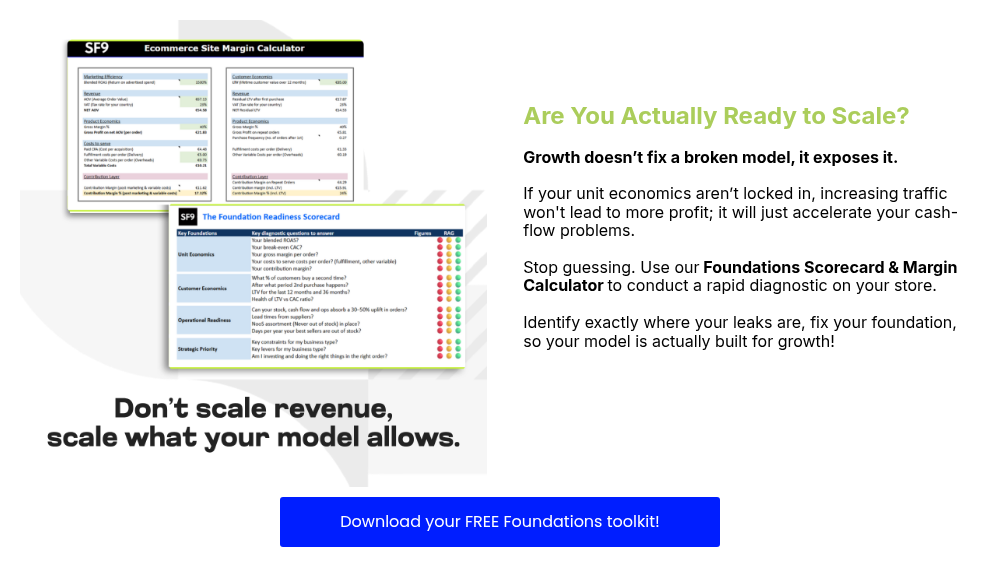
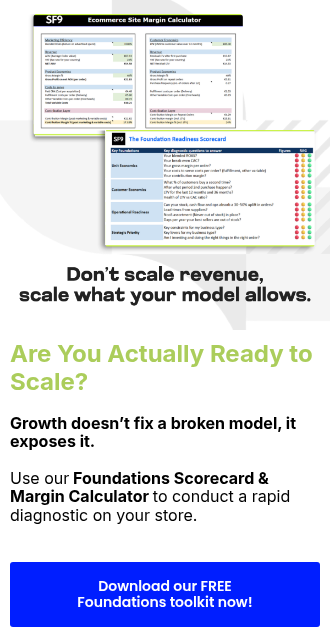
Our free Ecomm Foundations Scorecard Margin Calculator can help you work out where you should be focusing your attention.
You can use the scorecard to assess the four foundations of profitable ecommerce growth, then use the calculator to see what an order actually contributes after acquisition, payment, fulfilment and delivery costs.
Before you spend more to grow, make sure you know exactly what that growth will do to your profits.
Click here to access our free Ecomm Foundations Scorecard & Margin Calculator.

